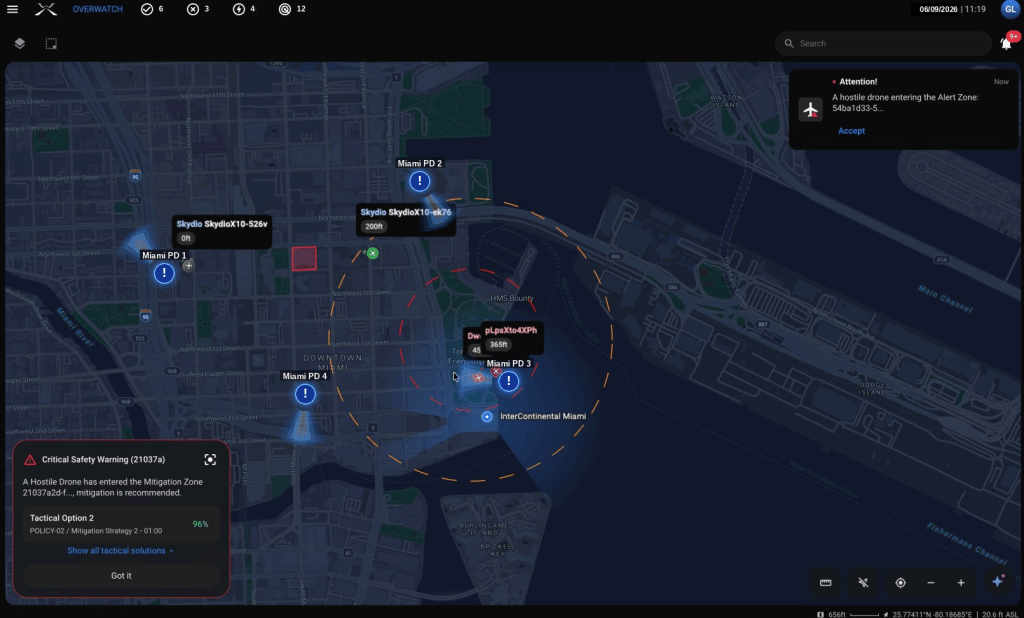

The rapid proliferation of drones, autonomous systems and artificial intelligence is creating a new challenge for the way low-altitude airspace is managed. According to Yaron Rosen, executive chairman of Airwayz and former Brig. Gen in the IAF, the problem is no longer simply how to detect or defeat individual drones. It is how to manage an increasingly dynamic airspace in which civilian aircraft, military systems, autonomous platforms and counter-UAS technologies all have to operate together.
Rosen sees the current transformation as the result of the convergence of three technologies. The first is the growing accessibility of flying objects, including drones that can be built and operated by an increasingly wide range of users. The second is autonomy, which allows these systems to perform increasingly complex tasks with less direct human involvement. The third is computing power, including artificial intelligence and edge computing.
“Autonomy has really expanded and modified how these objects can fly, even without a human in the loop,” Rosen said. The combination of these technologies, he argued, is creating “a very, very unique asymmetric challenge.”
While the same technological convergence will eventually affect land and maritime environments, Rosen believes airspace is the first domain where its effects are being felt at scale. The reason is the collision between a rapidly changing low-altitude environment and an airspace system that was designed around very different assumptions.
“When this thing meets the traditional airspace and how humans have been managing airspace in the last, let’s say, 100 years, this clash is very, very challenging,” Rosen said. “The airspace was not built to be dynamic.”
Traditional airspace management, he explained, is “very static, very rigid, very regular, very safe.” The emerging drone environment is the opposite. Small aircraft can appear rapidly, operate at low altitude and, depending on their design, become difficult to detect or track. At the same time, the systems responsible for managing the airspace remain divided between different organisations, technologies and authorities.
That creates a problem that cannot be solved simply by adding another sensor or another interceptor.
As drones became more widespread, the industry responded with an expanding ecosystem of sensors, effectors and counter-UAS systems. But Rosen argues that these capabilities need to operate as part of a single architecture. Airwayz is attempting to build what he describes as an operating system for airspace, bringing together the different components needed to plan, monitor, control and secure it.
“Everything needs to be integrated into one brain,” Rosen said.
The idea extends beyond counter-UAS. Rosen described a system that can connect airspace planning with sensors and effectors, while also incorporating command and control, decision support, rules of engagement and accountability. The objective is to create a common operating picture that allows operators to understand what is happening in the airspace and determine what action is authorised.
This becomes particularly important as the traditional distinction between civilian and military airspace becomes less clear.
“There are no lines between civilian and military suddenly,” Rosen said. “All these things together need to be dealt with in a very streamlined way.”
Rosen compared the challenge to a human body with multiple eyes, arms and legs but no brain to coordinate them. Without that coordinating layer, adding more capabilities can make the overall system more complicated rather than more effective.
“And right now it’s a mess,” he said.
Interoperability becomes critical
The challenge becomes even more pronounced when a drone crosses between different areas of responsibility. A single unmanned aircraft could move from an area under military control into civilian airspace, pass near an airport or critical infrastructure and continue across a national border. Each environment can have its own procedures, authorities and operating picture.
Rosen described a hypothetical scenario involving a drone travelling hundreds of kilometres across different jurisdictions. Once it crosses a border, responsibility can shift from one authority to another. Within a country, responsibility can then change again depending on whether the aircraft is approaching a military installation, critical infrastructure, an airport or another protected area.
“Each one of these entities has a different protocol, a different operating picture,” Rosen said. “There’s just no chance that you can deal with that.”
For Rosen, interoperability is therefore central to the problem. Sensors and effectors cannot simply be connected technically. They need to operate from a common understanding of what is happening in the airspace.
“That’s why you need a common protocol, a common operating picture,” he said. “And for that to happen, you need interoperability.”
Airwayz participated in a NATO technical interoperability exercise in the Netherlands designed to test how different technologies could operate together. Rosen said the exercise brought together dozens of sensor companies, effector companies and integrators.
Airwayz was part of a command-and-control group that worked alongside major defence companies. Rosen said the company integrated its system with more than 33 sensors and effectors during the exercise, including capabilities intended both for defence and mitigation.
The significance of the exercise, he said, was not simply demonstrating that individual systems could work. It was demonstrating that they could contribute to a shared understanding of the airspace.
“The challenge of getting different technologies to operate from a common understanding of the airspace, that is what is the most sophisticated and hard thing to do,” Rosen said.
Where humans remain in the loop
That common operating picture also determines how much autonomy can be introduced into the decision-making process.
Rosen described Airwayz’s approach as “supervised autonomy”, in which the system performs the data fusion and provides decision support while human operators retain authority where appropriate.
“The system does the fusion, and then it helps you decide what is a target, what is multiple targets, what is authorised, what is non-authorised,” he said.
Not every situation requires the same level of human involvement. In a rapidly developing scenario where there may not be enough time for a human operator to intervene, a system can act according to predetermined policies.
“The greatest example of that is Iron Dome,” Rosen said. “In certain ranges, threats are being mitigated with predetermined policy. So that is autonomy, and it’s done today.”
In other circumstances, there may be enough time for a human operator to consider additional factors before authorising an action. Those considerations could include operational priorities and the availability of munitions.
The move towards identified drones
Rosen also expects the regulatory environment around drones to become increasingly focused on identification and geographic restrictions.
Asked whether he expects a future in which drones would have to be registered and unidentified aircraft could be treated as unauthorised, Rosen said he believed the industry was moving in that direction.
“I think so,” he said. “It’s developing globally in the direction that you’re saying. All of them will have to have RFID or ID.”
He expects those requirements to vary according to the size and characteristics of the aircraft, as well as where it is operating. Some areas could remain relatively open to drone activity, while sensitive locations would impose significantly greater restrictions.
“The difference will be by size and by geography,” Rosen said. “You cannot fly anything in this area, but in this area you can fly freely.”
The principle, he suggested, is ultimately one of risk. Areas where there is little potential for harm could permit more freedom, while locations surrounding critical infrastructure, military bases and other sensitive sites could impose much stricter controls.
“The biggest thing is just to define areas by risk, and then people will be able to fly or not fly depending on where the risks are,” Rosen said.
He expects some existing practices around sensitive aviation infrastructure to disappear as the risks posed by small drones become harder to ignore. Rosen recalled visiting a naval air station where members of the public could stand close to the runway to photograph aircraft taking off and landing.
“If someone throws a stone, literally, they can take out an aircraft,” he said. “It’s really low over their heads.”
For Rosen, the same logic increasingly applies to drones. Areas around military and critical infrastructure facilities will have to be managed according to the potential consequences of an unauthorised flight.
The problem with seeing the unseen
The technological challenge is particularly difficult at low altitude, where small drones can be hard to detect.
“Drones are hard to detect in any case,” Rosen said. “So it just requires a different set of sensors. There’s no one sensor that solves everything, not at the moment.”
That means protected sites will require multiple types of sensors working together. Rosen expects the industry to continue developing technologies capable of detecting smaller and lower-flying objects, but he does not see a single technology emerging as a universal solution.
“In every critical infrastructure, or protected area, you will need a blend of sensors,” he said.
The problem is even more pronounced with fibre-optic FPV drones. Unlike conventional drones that can depend on radio-frequency communications, fibre-optic systems use a physical cable to maintain their connection to the operator.
“The FPV drones, the ones that are flying with the fibre-optic cable, are very hard to intercept,” Rosen said. “You have to literally shoot them down. You can’t take control. They have no RF signature.”
As these systems develop, mitigation will have to evolve alongside detection. Rosen pointed to the use of physical barriers around critical infrastructure as one example of how operators are adapting to the changing threat.
He also expects greater emphasis on very short-range mitigation.
“The mitigation at the end of the day will have to be the last mile mitigation, or even the last quarter mile mitigation,” Rosen said. “That is what’s going to happen in the next year or two.”
The appropriate response will depend heavily on the environment. In some locations, physical interception may be possible. In others, particularly densely populated civilian environments, operators may need to rely more heavily on soft-kill technologies.
“You can’t shoot a 30 mm gun in the middle of Tel Aviv,” Rosen said. “It doesn’t make sense.”
The challenge is therefore to combine different detection and mitigation technologies while ensuring that the operator understands what is happening across the entire system.
“Blending these capabilities, from the sensors to the mitigation and the middle, the operating system that will be the brain of all of these systems,” Rosen said.
An airspace problem, not simply a drone problem
For Rosen, the emergence of increasingly autonomous drones is part of a much larger technological shift. He does not see the development as surprising, drawing instead a parallel with developments that have already taken place in other technological domains.
“I’m not surprised,” he said. “I see a complete parallel of everything that’s going on in other domains.”
He compared the evolution of autonomous systems with the development of technologies used in asymmetric warfare and cyberspace. New technologies become available, their capabilities are demonstrated, and their use can expand rapidly once they become scalable and difficult to counter.
“Technology presents us all these new capabilities to fight from the bad side to fight and also from the good side, by the way, to fight asymmetric warfare,” Rosen said.
The speed of technological development, however, creates a particular challenge for governments and militaries.
“Governments, which are slow movers, and militaries and security organisations are much slower from technology relative to technology,” Rosen said. “All these things are catching up right now. We need to catch up fast.”
What concerns Rosen most is the convergence of physical systems, artificial intelligence, autonomy and human decision-making. As these technologies become more accessible, the barrier to deploying sophisticated unmanned systems continues to fall.
“This is a physical AI, autonomy and humans interaction,” he said.
Rosen expects the threat environment to develop faster than many organisations anticipate.
“It’s going to develop very fast,” he said. “A threat level will be presented much faster than we think.”
He pointed to developments in Europe as a warning that the issue is no longer a distant possibility.
“The things that are happening now in Europe are a huge, huge, red light,” Rosen said. “Guys, get ready. This is coming.”
For Rosen, the lesson from the evolution of cyberspace is that technological change can move faster than the institutions responsible for governing it. Drones and autonomous systems are now following a similar trajectory, becoming cheaper, more accessible and increasingly capable.
“It’s happening now with drones and autonomy and AI,” Rosen said. “We’re being attacked because it is democratised, it is commercialised, it is commoditised.”
That leaves airspace management facing a problem that extends beyond counter-UAS technology itself. The challenge is no longer simply detecting a drone or developing a system capable of defeating it. It is establishing the infrastructure, rules and decision-making architecture needed to manage a low-altitude environment where more aircraft, more autonomy and more actors are operating at the same time.
For Rosen, the central requirement is therefore coordination. Sensors need to see the same airspace. Operators need a common operating picture. Autonomous systems need to operate within defined policies. And humans need to remain able to intervene when the situation demands it.
Without that architecture, adding more technology risks creating more disconnected capabilities in an environment that is already becoming increasingly difficult to control.
Brig. Gen. Yaron Rosen (Res.) is the executive chairman of Airwayz, the world’s first airspace governance platform and the coordination layer for autonomous airspace. Rosen joined Airwayz in 2025, bringing nearly four decades of military leadership and extensive experience across cyber, air power and technology entrepreneurship.
Photo Credits: Airwayz


Leave a Reply