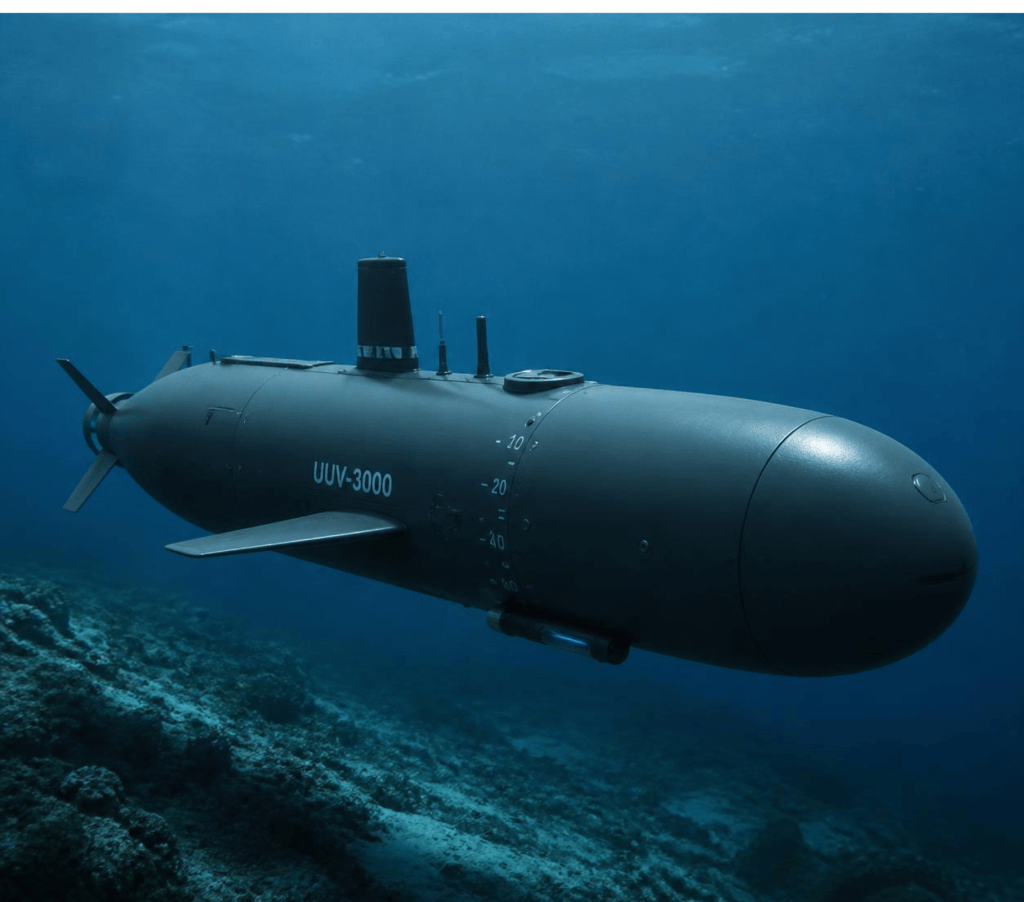
When Iranian state television broadcast footage of Revolutionary Guards hauling a sleek, torpedo-shaped robot from the waters near the Strait of Hormuz in September 2026, the scene looked like another round in the long game of maritime brinkmanship. The vessel on display was an American-made Dive-LD, a 19-foot autonomous underwater drone built to spend days submerged, mapping the seabed, hunting mines and gathering intelligence without a crew. Yet the real drama was unfolding far from the Persian Gulf. In the cold, cluttered waters of the Black Sea, Ukrainian forces were already using similar machines to strike at Russian submarines. Across the Indo-Pacific, Chinese gliders were slipping through disputed waters, mapping the ocean floor while Philippine fishermen pulled them from their nets. The Hormuz incident was but a glimpse of how underwater drones are shaking up how navies fight, spy and deter across the world’s most contested seas
The underwater drone market is expanding rapidly, fuelled by dual-use requirements, technological innovation and rising geopolitical tensions. Industry analysts put the global autonomous underwater vehicle (AUV) market at roughly $4.2 billion to $4.3 billion in 2025 to 2026, with projections reaching $14 billion to $15 billion by the early 2030s as navies invest in long-endurance, AI-enabled systems. The military segment alone was valued at about $2.8 billion in 2025 and is forecast to approach $9 billion by 2034, with extra-large UUVs (XLUUVs) already accounting for over 40 percent of platform revenue.
Procurement programmes give these figures substance. The U.S. Navy’s Boeing-built Orca XLUUV, Australia’s Ghost Shark programme with Anduril and Boeing, the UK’s CETUS extra-large UUV and a host of smaller tactical systems for mine countermeasures, harbour security and undersea surveillance are all moving from prototype to fleet. The question now centres on how many can be deployed, how long they can remain on station and how securely they can connect to the forces operating them.
The Black Sea has become the most vivid proving ground for unmanned undersea warfare. According to Ukraine’s Security Service (SBU), Ukrainian forces have, for the “first time,” successfully damaged a Russian Navy submarine using an unmanned underwater vehicle (UUV). The target was identified as a Project 636.3 Varshavyanka-class (Kilo-class) submarine. The SBU claimed the attack caused an onboard explosion and fire, rendering the vessel inoperable. This incident marked the second offensive action against a Kilo-class submarine of Russia’s Black Sea Fleet, following a September 2023 strike at Sevastopol that combined cruise missiles and uncrewed surface vessels.
Ukrainian forces have paired surface “kamikaze” drones with underwater systems to pressure a numerically superior Russian fleet, targeting warships, logistics and infrastructure while minimising risk to personnel. These operations highlight a central strategic appeal of underwater autonomous vehicles. They can accept risks that commanders would hesitate to impose on a manned system, entering contested areas, conducting surveys or attacks and potentially being lost without putting sailors inside the threat envelope.
In the Indo-Pacific, underwater drones are central to competition below the threshold of open conflict. In the disputed waters of the South China Sea, including areas within Philippine territorial waters, fishermen have recovered multiple Chinese unmanned underwater vehicles (UUVs). Though unarmed, these devices were equipped with oceanographic sensors to map the ocean floor, potentially supporting submarine navigation and other military purposes. Since 2022, the Philippine Coast Guard has recovered at least six Chinese-origin UUVs, most resembling the PLA-adopted “Sea Wing” glider, which in larger numbers could support submarine detection and tracking.
These recoveries highlight a dual reality. Underwater drones enable persistent, low-profile data collection in contested waters without overtly aggressive posturing. Their presence also creates friction. Recovery incidents, diplomatic protests and the constant risk that a lost vehicle becomes an intelligence windfall for an adversary are now routine. As unmanned systems become more common, adversaries will increasingly seek to capture them, study their components and understand the networks that support them.
Underwater systems face a different set of constraints from aerial drones. GPS signals do not provide continuous positioning beneath the surface, while conventional radio communications become difficult or impossible at depth. The vehicle therefore has to navigate and manage much of its mission independently before resurfacing or reaching a point where information can be transmitted. This places enormous demands on power systems, navigation architecture and fault-tolerant software.
At the high end, extra-large UUVs are redefining what an “underwater drone” can be. Boeing’s Orca XLUUV, for example, is 26 metres long, displaces roughly 85 tonnes and features an 8-tonne payload capacity with an operational range of 6,500 nautical miles. In July 2026, the U.S. Navy completed a 1,000-nautical-mile autonomous transit across the East Pacific using Orca, a first in the programme’s history and a defining moment for the global AUV market. Australia’s Ghost Shark, developed under a AUD 1.2 billion contract, represents the first operational XLUUV outside the United States, with long-range ISR, mine-laying and potentially strike capabilities at a cost estimated at 5 to 10 times lower than a conventional attack submarine.
Smaller systems like Anduril’s Dive-LD occupy a different niche. They are large enough to carry generous payload bays and open interfaces, yet small enough to be pier-launched, towed to sea or stow-launched from suitable vessels. With advertised endurance of up to 10 days (scaling toward multi-week missions), speeds of two to seven knots and operating depths around 6,000 metres, they are designed for persistence, discretion and data collection rather than high-speed pursuit. Their modular, free-flooded payload bays support missions ranging from intelligence preparation of the operational environment (IPOE) and ISR to mine warfare, seabed mapping, infrastructure inspection and precision payload placement.
The Dive-LD incident in the Strait of Hormuz highlights a recurring theme. A lost vehicle can provide an adversary with useful information even when its mission data remains protected. Engineers can examine physical construction, propulsion and power architecture, navigation equipment, communications systems and sensor integration. Analysts cited in reporting said Iranian engineers could potentially reverse engineer mechanical systems and some electronics, while encrypted software would present a much harder barrier.
This pattern extends beyond the Middle East. In 2011, Tehran recovered an American RQ-170 reconnaissance drone and subsequently claimed to have reverse engineered it. In 2022, Iranian forces also attempted to seize an American Saildrone surface vehicle in the Gulf before U.S. forces intervened. In the South China Sea, recovered Chinese UUVs have given other actors tangible insight into sensor suites, hull forms and deployment concepts. As unmanned systems proliferate, physical security and recovery planning become integral to mission design.
The strategic appeal of underwater autonomous vehicles comes down to persistence. A crewed submarine is an extraordinarily capable platform, yet it is expensive, limited in number and constrained by the need to protect its crew. An autonomous vehicle can accept risks that commanders would hesitate to impose on a manned system. It can enter a contested area, conduct a survey and potentially be lost without putting sailors inside the threat envelope.
This creates the possibility of distributing underwater sensing across many vehicles rather than concentrating capability inside a handful of large platforms. A fleet of underwater vehicles could support mine detection, seabed mapping, anti-submarine operations and maritime surveillance across areas that would be difficult to monitor continuously with crewed platforms alone. The value comes from combining persistence with relatively low risk to personnel.
The technology still faces serious constraints. Long-duration underwater operations demand reliable propulsion and power systems, accurate navigation and robust sensors. Communications remain difficult beneath the surface, and a malfunction can turn an expensive autonomous asset into a recovery problem, as the Dive-LD incident demonstrated. Yet the trajectory is clear. Navies are moving from experimental prototypes to operational fleets, from single-platform demonstrations to distributed undersea networks.
The ocean has always favoured the side that can see without being seen. Autonomous underwater vehicles are giving navies a new way to compete for that advantage, not just in flashpoints like the Strait of Hormuz but across the world’s most contested waters.


 The Defense Circuit
Leave a comment