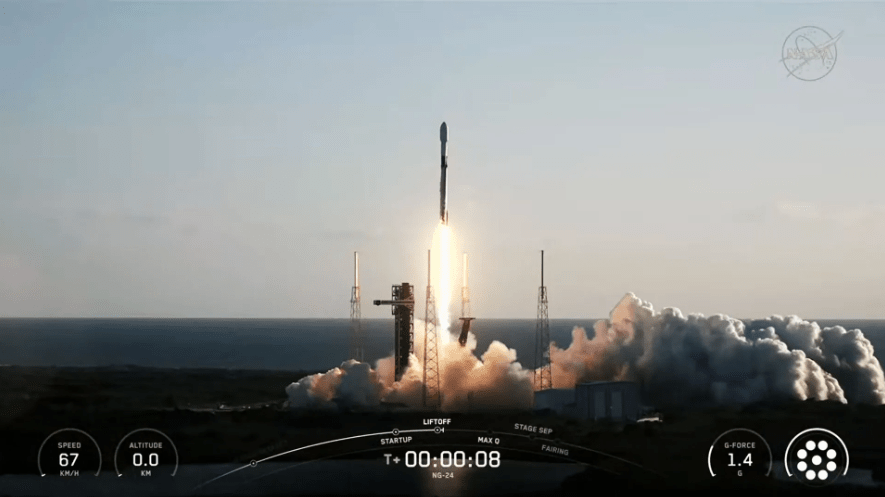
The launch of Northrop Grumman’s Cygnus XL cargo spacecraft on Friday morning was, on its surface, a routine resupply mission to the International Space Station. But beneath the steady cadence of scientific logistics lies a quieter strategic reality: the infrastructure sustaining low-Earth orbit is increasingly dependent on a tightly interwoven commercial industrial base—one that now resembles critical national logistics architecture as much as civilian science support.
At 7:41 a.m. EDT on April 11, 2026, a SpaceX Falcon 9 lifted the NG-24 Cygnus XL mission from Cape Canaveral Space Force Station in Florida, sending more than 11,000 pounds of supplies and experiments toward the International Space Station. The spacecraft is scheduled to arrive on April 13, where it will be captured by the station’s robotic arm and berthed to the Unity module for operations supporting Expedition 74.
The mission is part of NASA’s Commercial Resupply Services program, but its execution reflects a broader structural shift in how the United States maintains continuous presence in orbit: government requirements are now fulfilled through distributed commercial partnerships spanning multiple competing contractors.
Northrop Grumman’s Cygnus XL represents the latest evolution in this system, carrying roughly one-third more cargo than earlier versions of the spacecraft. That increase in capacity is not simply an efficiency upgrade—it is an operational adjustment to the growing logistical demands of sustained human activity in low Earth orbit, where every kilogram delivered supports not only research but also station maintenance and crew survival systems.
In parallel, the launch arrangement itself underscores an important feature of today’s space industrial base: interdependence between competitors. While Northrop Grumman builds the Cygnus spacecraft, it relies on SpaceX’s Falcon 9 rocket to place it into orbit. That arrangement has become routine since the retirement of the Antares 230+ rocket line in 2023, and delays in its replacement have extended that reliance further than originally anticipated.
From a defense and resilience perspective, this layered dependency structure cuts both ways. On one hand, it provides redundancy in access to orbit, reducing reliance on any single launch provider. On the other, it concentrates critical launch capacity into a smaller number of operational systems, particularly Falcon 9, which now underpins a wide range of U.S. civil and commercial missions.
Cygnus itself carries no military payloads. Its manifest consists of crew supplies, station hardware, scientific experiments, and operational equipment for the ISS. But its capabilities—including limited reboost functionality to help maintain the station’s orbital altitude—highlight the increasingly dual-use character of space infrastructure. Orbital maintenance, navigation support, and sustained human presence are all foundational to both civil science and broader national space resilience.
The NG-24 spacecraft, named the S.S. Steven R. Nagel in honor of a former NASA astronaut and Air Force pilot, continues a long line of Cygnus missions that have collectively delivered more than 158,000 pounds of cargo to the station since 2013. That sustained throughput has become an often-overlooked pillar of U.S. space operations: the ability to reliably move mass into orbit on demand.
Yet the broader context surrounding this mission points to emerging pressures. NASA budget projections for future fiscal years indicate potential constraints on ISS operations funding, which could in turn affect cargo cadence and crew provisioning. Any reduction in resupply frequency would immediately translate into tighter margins for both scientific output and station operations.
In that sense, Cygnus XL represents more than a logistics vehicle. It is part of a distributed industrial system that now underwrites American presence in orbit. The architecture is commercially driven, operationally complex, and strategically significant—less a traditional space program than a supply chain extending 400 kilometers above Earth.
As the spacecraft approaches rendezvous with the ISS, the mission continues as planned. But the broader trajectory is clear: the ability to sustain human activity in space is no longer defined solely by launch capability or scientific ambition. It is increasingly defined by the resilience of the commercial logistics networks that quietly keep orbital infrastructure functioning day after day.

 The Defense Circuit
Leave a comment