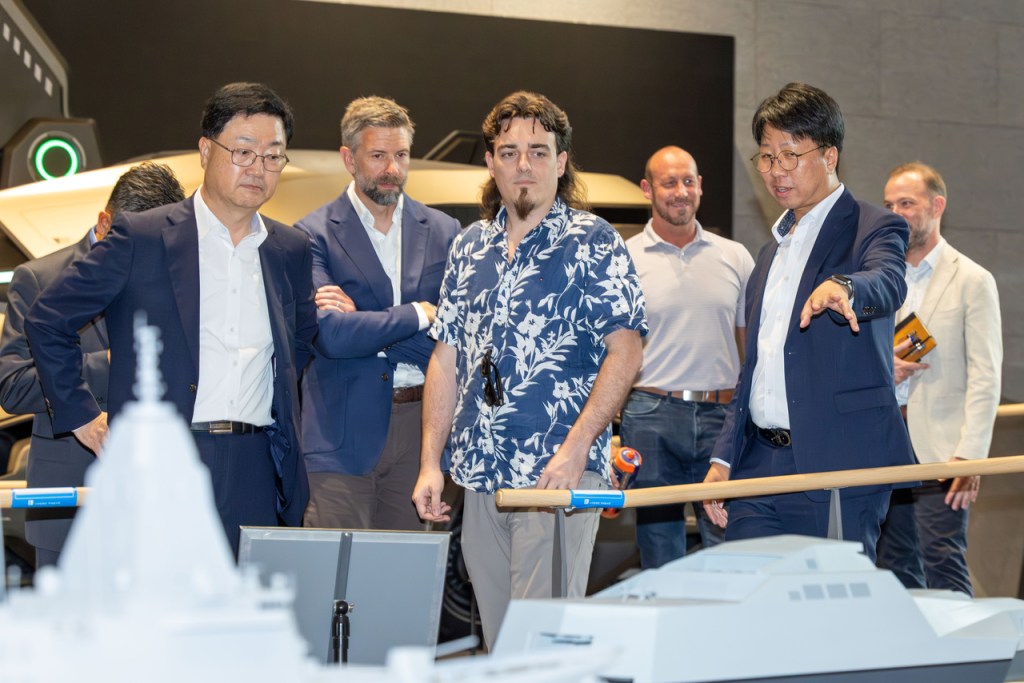
Anduril Industries has partnered with South Korea’s HD Hyundai Heavy Industries to design and build a new class of autonomous surface vessels, the companies announced Thursday. The collaboration will produce an initial dual-use prototype in Korea and establish a U.S. manufacturing and test hub at the former Foss Shipyard in Seattle to support future production.
The move positions Anduril to compete for the U.S. Navy’s Modular Attack Surface Craft (MASC) program, which combines elements of the Navy’s previous large and medium unmanned surface vessel efforts. The Navy earlier solicited industry pitches for three MASC prototypes: a standard variant, a high-capacity version, and a single-payload design.
“The first dual-use ASV prototype is currently being fabricated in Korea,” the companies said. Anduril said future vessels, including a MASC variant, will be built completely in the United States at the Puget Sound facility, which the company has invested tens of millions of dollars to renovate. That site will be Anduril’s “initial U.S. hub for low-rate vessel assembly, integration, and testing of ASVs for the MASC program,” the company said.
Anduril executives described the partnership with HD Hyundai as a way to accelerate delivery and scale production. “We’ve been working this for some time. So we’re cutting steel in the U.S. We’re cutting steel in Korea already,” said Shane Arnott, Anduril’s senior vice president of programs and engineering. “We’re hopeful that [the MASC competition] comes our way, and that will certainly accelerate the plans.”
Chris Brose, Anduril’s president and head of strategy, acknowledged the firm has not previously produced surface warships at scale but said teaming with one of the world’s largest shipbuilders reduces that risk. “We’ve never delivered it at scale, but we’re teamed with one of the world’s largest and leading ship builders,” Brose said. “With that partnership, through the design, the development and then ultimately, the delivery of scale, we’ll feel very confident that the Anduril-Hyundai team can deliver what the U.S. Navy needs, and a lot more beyond that.”
The companies said the ASV design emphasizes modularity and open architecture so a single hull can be reconfigured for missions such as intelligence, surveillance, strike, and electronic warfare by swapping payloads. Anduril also highlighted software-defined integration that unifies propulsion, navigation and payload control, with an eye toward sustainment and avoiding vendor lock.
Anduril framed the effort as part of a broader push to expand U.S. maritime industrial capacity. The firm is partnering with Hadrian to modernize manufacturing and apply automated fabrication techniques intended to shorten lead times for structural components and subsystems.
The announcement comes as several new entrants and established firms pursue unmanned surface vessels. Anduril pointed to global demand for affordable, mass-producible maritime platforms and said allies and partners are likely markets if the U.S. Navy adopts the concept at scale.
Industry analysts caution that shipbuilding remains complex and capital-intensive, and ramping to “dozens of ships per year,” as Anduril has discussed, will require supply-chain depth, skilled labor and proven production processes. Anduril said it has been deliberate on material choices and workforce planning, and it plans to leverage HD Hyundai’s shipbuilding experience to de-risk early production.
The partnership links Anduril’s autonomy and mission-systems expertise with HD Hyundai’s industrial capacity. The first prototype in Korea will test design and integration, while the Seattle facility will focus on U.S. assembly, integration and testing ahead of potential fleet buys.
 The Defense Circuit
Leave a comment