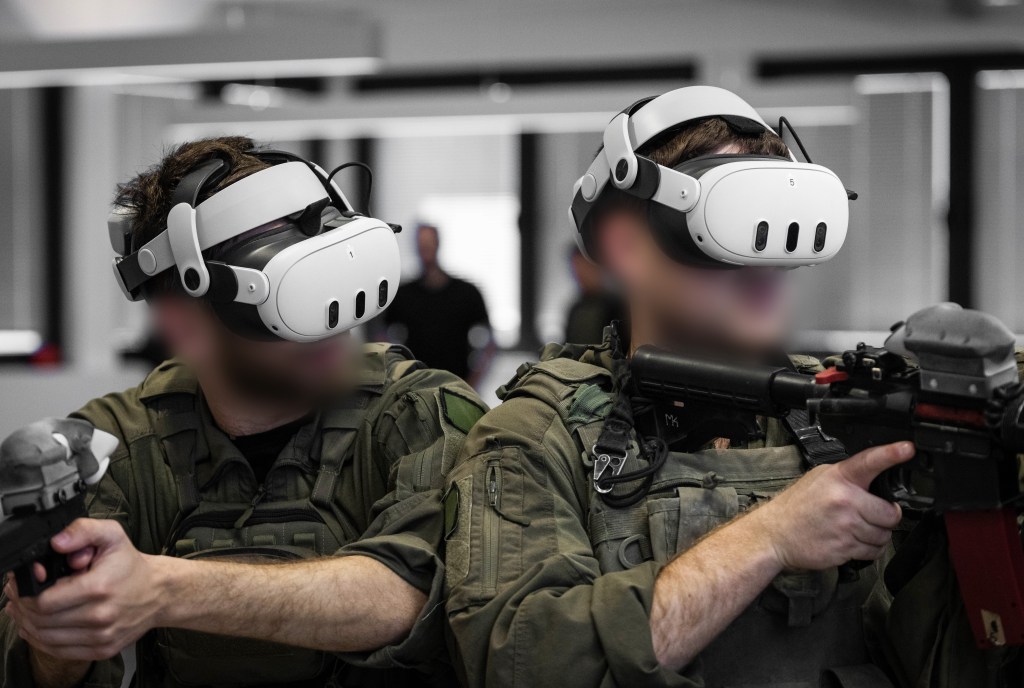
Combatica, an Israeli defense tech firm, is redefining tactical training with a Virtual Reality (VR) platform already in use by special forces across four continents. Recognized by Frost & Sullivan as the global market leader in Special Operations Forces (SOF) training systems, the company is bridging the worlds of defense, gaming, and simulation technologies.
“We started by over-engineering everything,” said Erel Herzog, Combatica co-founder and Chief Strategy Officer, in an interview with The Defense Circuit. “Seven people, two carts, four hours to set up. It collapsed under its own complexity. We knew we had to start over.”
That pivot resulted in Combatica 2.1–VR training system that fits into three pelican cases, requires only a power outlet (or a battery), and can be operational within 10 minutes. Unlike legacy systems, Combatica doesn’t rely on backpacks, body sensors, external cameras, or server farms. “You put on the headset, hold a gun, and that’s it,” Herzog explained.
The ease of setup and mobile-friendly design have allowed Combatica to deploy the system in military and law enforcement contexts ranging from Jerusalem’s light rail security teams to elite units worldwide. “It’s Call of Duty in VR,” Herzog added, noting that the realism and physicality of the experience sets their platform apart. “You’re sweating, you’re running, you’re in it.”
Combatica’s advantage isn’t just portability—it’s psychological fidelity. The system tracks every action: bullet trajectories, hits, civilian casualties, even friendly fire incidents. This allows users to rapidly replay scenarios and correct mistakes, something Herzog says is unattainable in traditional live training.
“We had a trainee shoot a hostage by mistake. We ran the same scenario ten more times until he got it out of his system,” Herzog recounted. “You can’t do that at a live range.”
The company also integrates detailed performance analytics and stress-response monitoring into its platform, using wearable tech like Garmin smartwatches to track heart rate and decision-making under pressure.
Combatica provides clients with the tools to create their own custom scenarios—whether it’s clearing a terrorist cell in a school or defusing a hostage situation in a crowded train station. The platform has proven adaptable to evolving threats, with client requests often driving new feature development.
One recent example: a Latin American law enforcement agency used the system for roleplay-based de-escalation training. “They asked, what if one of our guys plays a suspect, and the trainees have to talk him down instead of shooting?” Herzog said. “That wasn’t in the original design—but we built the tools to support it.”
Combatica’s stripped-down design and client-driven approach helped earn Frost & Sullivan’s recognition. “We didn’t apply for it. They came to us,” Herzog said. “It was a real morale boost.”
Despite being a relatively small company, Combatica has tripled its sales over the past year. While Herzog declined to disclose specific countries or regions, he confirmed that most of their growth has come from elite units and defense ministries prioritizing mobility, adaptability, and cognitive training.
The company recently launched a VR gaming arena in Uganda, with plans to expand to the U.S., Europe, and Israel by 2026. “Same system, just used to train soldiers during the day and entertain civilians in the evenings.”
Combatica sees the future of training as immersive, modular, and scalable. “We’re here to actually save lives… to play a small part in helping save a few lives here and there,” Herzog concluded.

 The Defense Circuit
Leave a comment