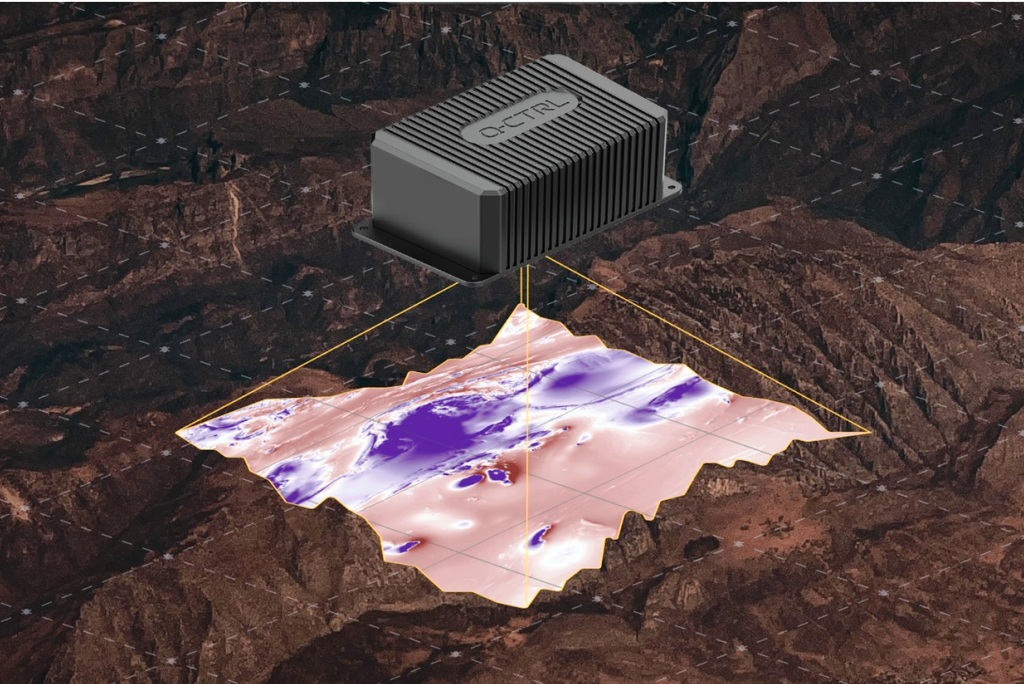
The U.S. Defense Advanced Research Projects Agency (DARPA) has selected Australian quantum technology company Q-CTRL for two contracts under its Robust Quantum Sensors (RoQS) program, awarding the firm $24.4 million to develop next-generation quantum navigation tools for military vehicles. Lockheed Martin will act as a subcontractor on one component of the program, underscoring U.S. defense industry interest in quantum navigation.
For decades, militaries have relied on the Global Positioning System (GPS) for precision navigation. But in contested environments—from the Western Pacific to Eastern Europe—GPS is increasingly vulnerable to jamming, spoofing, and denial by adversaries. This has elevated the urgency for alternative navigation technologies that can operate independently of satellite signals. Quantum sensors provide one of the most promising solutions. By measuring subtle variations in gravity and magnetic fields, quantum devices can determine precise location and movement without relying on external signals. In theory, such systems could guide aircraft, submarines, or armored vehicles through GPS-denied environments with unmatched accuracy. The challenge, until recently, has been making these laboratory-grade instruments rugged enough to function on real-world defense platforms subject to vibrations, shocks, and electromagnetic interference. DARPA’s RoQS program was created to overcome this barrier—accelerating the transition of quantum navigation from the physics lab to the battlefield.
Q-CTRL has emerged as a leader in this transition. The company’s Ironstone Opal quantum navigation system has already demonstrated 111-fold greater accuracy than a high-end inertial navigation system (INS) during flight trials when GPS was unavailable. In maritime trials aboard the Royal Australian Navy’s MV Sycamore, the technology operated continuously for 144 hours, navigating by detecting variations in Earth’s gravity field. What sets Q-CTRL apart is its AI-powered “software ruggedization”—a layer of machine learning that stabilizes quantum sensors against the noise and interference of moving platforms. This eliminates the need for bulky shielding or isolation hardware, making the systems more deployable for military use.
CEO Michael J. Biercuk said the DARPA awards validate Q-CTRL’s mission:
“DARPA has an incredible track record of delivering innovations that change the face of society, from the internet and mobile phones to night vision and stealth. We’re honored that our demonstrations and new ideas earned selection to deliver a new generation of software-ruggedized quantum sensors for the most challenging defense missions.”
Q-CTRL will collaborate with Lockheed Martin, which brings decades of experience in GPS and navigation technology. The program builds on their prior work with the U.S. Department of Defense’s Defense Innovation Unit (DIU) to prototype a quantum-enabled inertial navigation system, known as QuINS. U.S. government agencies are also taking notice. NASA and the U.S. Geological Survey (USGS) are exploring uses of mobile quantum sensors for subsurface mapping, mineral prospecting, and GPS-denied navigation—applications with both defense and commercial impact. Jonathan Stock, Chief Scientist for Innovation at NASA Ames, noted that the DARPA awards highlight the technology’s broader significance:
“The emerging generation of highly capable, mobile quantum sensors can detect and assess mineral deposits and map out detailed subsurface patterns. DARPA’s awards to Q-CTRL illustrate the potential for impactful new use of this technology.”
The push for quantum navigation is part of a wider quantum technology race among major powers. While much public attention has focused on quantum computing, quantum sensing has matured faster and is closer to field deployment. Aerospace primes like Airbus are investigating magnetic navigation, while defense agencies in the U.S., Europe, and Asia are investing in quantum solutions for land, sea, air, and space platforms. For defense planners, the appeal is clear: resilient positioning, navigation, and timing (PNT) is essential for modern warfare. As electronic warfare capabilities proliferate, quantum navigation could offer the redundancy and assurance militaries need in future conflicts.
DARPA’s investment in Q-CTRL underscores the growing urgency of developing resilient navigation systems as GPS denial becomes a central feature of modern conflict. By advancing ruggedized quantum sensors from field trials to operational platforms, the program aims to deliver a capability that could decisively reduce reliance on vulnerable satellite signals and strengthen the technological edge of U.S. and allied forces.



 The Defense Circuit
Leave a comment