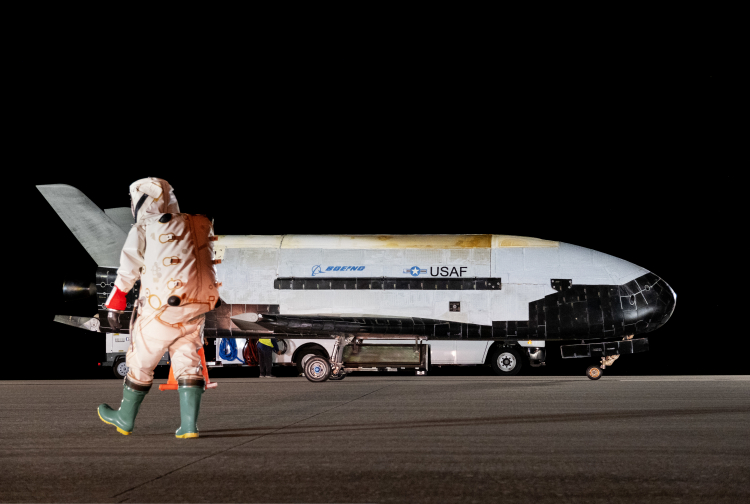
The U.S. Space Force is preparing to launch the eighth mission of its secretive X-37B Orbital Test Vehicle, a reusable spaceplane developed by Boeing, with a payload that includes advanced quantum navigation technology and next-generation optical communication systems. The mission, designated OTV-8, is scheduled to lift off from Kennedy Space Center aboard a SpaceX Falcon 9 rocket (USSF-36) on August 21.
While much of the X-37B program remains classified, officials confirmed that this mission will mark a significant step forward in space-based experimentation with emerging dual-use technologies. Among the most closely watched payloads on board is a quantum inertial sensor developed under a Defense Innovation Unit (DIU) initiative by California-based firm Vector Atomic. The device, according to program officials, represents the highest-performing quantum sensor of its kind ever launched into orbit.
The sensor will attempt to demonstrate precision navigation capabilities without relying on the Global Positioning System (GPS), a crucial feature for operating in contested or GPS-denied environments. “This is a major milestone in advancing robust navigation capabilities for the Department of Defense,” said Space Delta 9 Commander Col. Ramsey Hom in a statement. The technology, he noted, could enable future space systems to maintain accurate position and velocity data independent of satellite-based navigation—especially valuable in regions like cislunar space where GPS coverage does not exist.
Quantum inertial sensors exploit the properties of supercooled atoms manipulated by lasers to detect acceleration and rotation with extreme precision. Unlike conventional inertial systems, which drift over time and must be corrected via GPS, quantum sensors offer long-term stability and immunity to jamming or spoofing. The OTV-8 experiment builds on years of terrestrial testing, but this marks the first time a strategic-grade quantum inertial unit will be tested in space.
The relevance of this experiment extends far beyond basic science. As potential adversaries field increasingly capable electronic warfare systems and space-based countermeasures, the U.S. military is pursuing alternative positioning, navigation, and timing (PNT) solutions that are both hardened and self-sufficient. Quantum sensors are widely viewed as a promising cornerstone of such efforts.
In addition to the navigation payload, OTV-8 will also support laser communications experiments designed to test high-bandwidth, secure optical links between satellites and ground stations. These tests will help evaluate technologies for a more resilient, distributed communications architecture—one that aligns with the Space Force’s broader push toward interoperability with proliferated commercial constellations.
Boeing’s X-37B, which resembles a miniature space shuttle, has long served as a testbed for advanced military space capabilities. Since its first mission in 2010, the uncrewed vehicle has spent more than a decade in orbit, supporting classified experiments and setting endurance records for reusable spaceflight. OTV-7, its most recent mission, lasted over 900 days on orbit before returning to Earth in December 2022.
The launch of OTV-8 comes amid a surge of investment across the U.S. defense enterprise in quantum technologies, including sensing, computing, and communications. DIU, in particular, has accelerated timelines for transitioning quantum sensing from laboratory to orbit. According to DIU program manager Kyle Werner, this mission underscores how quantum advancements are moving “from whiteboards to spaceflight” in a matter of months.
If successful, the quantum inertial navigation demonstration aboard the X-37B could lay the groundwork for integrating GPS-free navigation systems into future military spacecraft, autonomous vehicles, and even long-range aircraft. With increasing concerns over the vulnerability of space-based infrastructure, resilient alternatives like quantum PNT are becoming central to U.S. defense strategy.
As the launch date approaches, the OTV-8 mission promises to be more than a routine deployment of a classified platform, it may signal the beginning of a new era of space autonomy powered by quantum physics.



 The Defense Circuit
Leave a comment