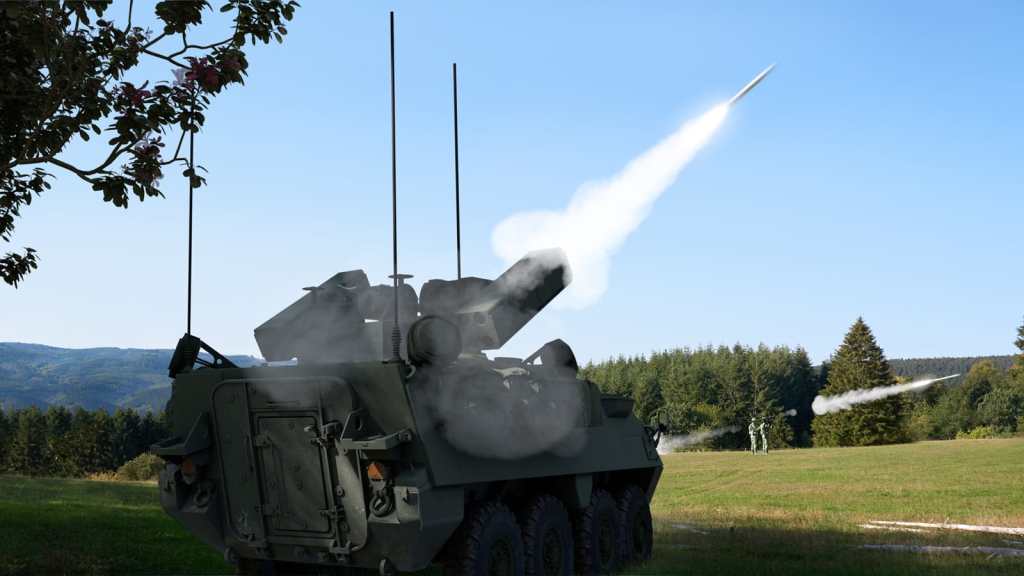
The U.S. Army’s effort to replace its aging Stinger missile is gaining momentum, with RTX announcing successful completion of ten subsystem demonstrations for its Next-Generation Short-Range Interceptor (NGSRI). The program has taken on increased urgency as thousands of existing Stinger missiles have been transferred to Ukraine while the drone threat continues to evolve globally.
RTX completed the subsystem demonstrations over recent months, including tests of the seeker assembly, rocket motor, command launch assembly, and warhead. The new interceptor’s seeker demonstrated target acquisition ranges “far exceeding Stinger in both laboratory and outdoor environments,” while the rocket motor showed extended intercept range capabilities. The command launch assembly demonstrated enhanced range for operator detection and identification of aerial targets in low-visibility environments, and arena testing confirmed the warhead’s effectiveness against various aerial threats.
“These successful subsystem demonstrations are a crucial step in meeting the U.S. Army’s range and performance requirements for this transformational short-range air defense capability,” said Tom Laliberty, president of Land & Air Defense Systems at RTX. “We are confident in our ability to rapidly deliver the Army an affordable, low-risk, highly producible NGSRI solution.”
The Army’s five-year competition is expected to take five years to develop and qualify the new interceptor and move into low-rate production. In the first two years, RTX and Lockheed Martin will develop missiles and build a “very small quantity” of them for testing. After a fly-off between the competitors, both vendors could progress to a second phase of rapid prototyping if they perform well.
The U.S. has transferred more than 3,000 Stingers to Ukraine. In response, the Pentagon placed a $624 million order for at least 1,300 new missiles in 2022 – the first such order in two decades. RTX has now ramped up to achieve production capacity of 60 Stingers monthly.
Lockheed Martin reports it has conducted two soldier touchpoints that “resulted in positive feedback from the warfighters present,” according to Randy Crites, vice president of advanced programs for Lockheed Martin’s missiles and fire control business. The company is preparing for multiple flight tests this year.
The new interceptor must be capable of defeating rotary-wing aircraft, Group 2-3 unmanned aircraft systems, and fixed-wing ground attack aircraft with capabilities exceeding the current Stinger. Like its predecessor, the NGSRI will be deployable both as a man-portable system and from vehicle-mounted launchers.


 The Defense Circuit
Leave a comment